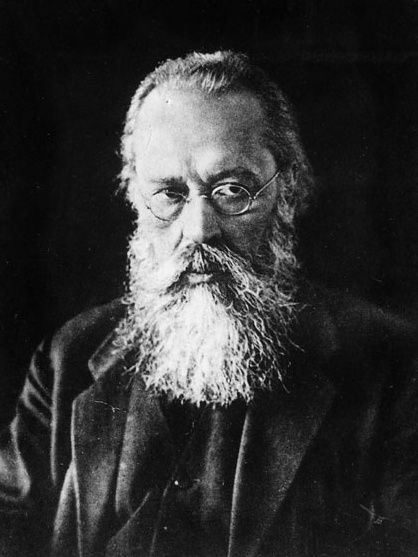
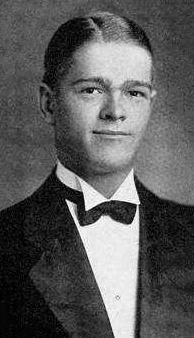
Today is the birthday of
- Vladimir
Steklov (1864-1926)
- Thomas T. Goldsmith Jr. (1910-2009).
Today’s Problem: Conservation of energy implies Kirchhoff current law
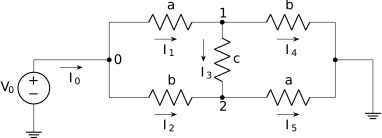
Show that conservation of energy in this circuit implies that the Kirchhoff current law (KCL) must be obeyed at each node.
The power delivered to the circuit is \(V_0I_0\). For conservation of energy to hold this must equal the power dissipated by the resistors in each branch of the circuit. The following equation must therefore hold:
\[\begin{eqnarray}V_0I_0 &=& (V_0-V_1)I_1 + (V_0-V_2)I_2 + (V_1-V_2)I_3 + V_1I_4 + V_2I_5\nonumber\\ &=& V_0(I_1+I_2) + V_1(I_3+I_4-I_1) + V_2(I_5-I_2-I_3)\nonumber \end{eqnarray}\] or, collecting all node voltage terms together, we have
\[V_0(I_1+I_2-I_0) + V_1(I_3+I_4-I_1) + V_2(I_5-I_2-I_3) = 0\]
The only way this can equal \(0\) for any arbitrary set of node voltages \((V_0,V_1,V_2)\) is if the coefficients of the node voltages are zero. So we must have
\[\begin{eqnarray}I_0 &=& I_1 + I_2\nonumber\\ I_1 &=& I_3 + I_4\nonumber\\ I_5 &=& I_2 + I_3\nonumber \end{eqnarray}\]
These equations are the KCL applied to nodes \(0,1,2\). Note that no functional relationship between the voltage across and the current through a branch was assumed. Although the circuit diagram shows resistors, the element in each branch could be anything.
© 2026 Stefan Hollos and Richard Hollos