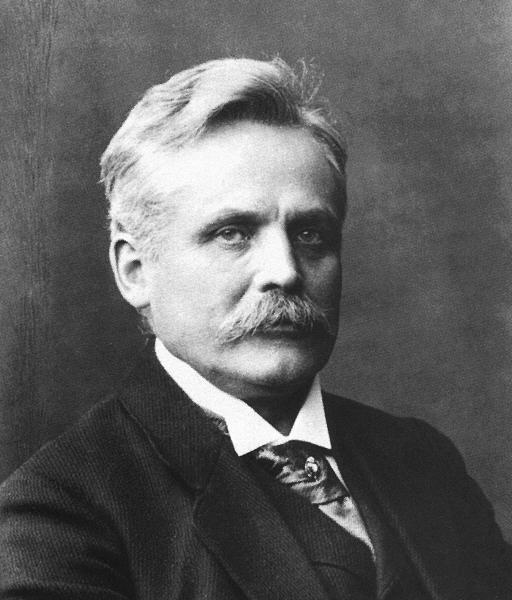
Today is the birthday of
- Wilhelm Wien (1864-1928).
Today’s Problem
For an ideal gas of \(N\) particles, there are \(fN\) total degrees of freedom where \(f\) is the number of degrees of freedom per particle (3 for a monatomic gas, 5 for a diatomic gas, etc). By the equipartition theorem the total energy of the gas is then
\[U = \frac{f}{2}NkT\]
Show that for an adiabatic expansion of this gas \(PV^\gamma\) is constant where \(\gamma=1+2/f\).
Answer
For an adiabatic expansion there is no heat transfer so the change in internal energy is
\[dU=-PdV=\frac{f}{2}NkdT\]
For an ideal gas \(PV=NkT\). Substituting this into the above equation and simplifying we get
\[\frac{f}{2}\frac{dT}{T}=-\frac{dV}{V}\]
Integrating this equation we find that \(VT^{f/2}\) is a constant. Or equivalently, \(V^{2/f}T\) is a constant. Substituting \(T=PV/Nk\) we find that this is also equivalent to \(PV^\gamma\) is constant.
© 2026 Stefan Hollos and Richard Hollos