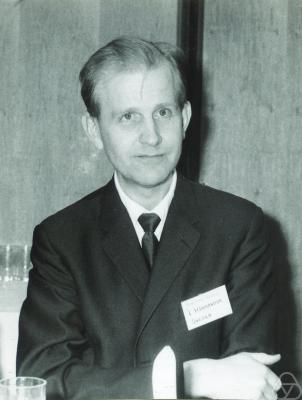
Today is the birthday of
- Lars
Hörmander (1931-2012).
Image from Konrad Jacobs under the Creative Commons Attribution-Share Alike 2.0 Germany license.
Today’s Problem
Given the results of the last problem, what is the compression limit \(V_f/V_i\) for a monatomic and diatomic gas?
Answer
In the last problem, the compression ratio was found to be given by
\[\frac{V_f}{V_i}=\frac{\gamma -1}{\gamma}+\frac{P_i}{\gamma P_f}\]
where the ratio of the pressures can be expressed in terms of the masses as follows
\[\frac{P_i}{P_f}=\frac{m_0}{m_0+m_1}\]
\(m_0\) is the mass of the piston, and \(m_1\) is the mass that is dropped onto the piston. To find the maximum compression ratio, set \(m_1=\infty\). The pressure ratio is then \(P_i/P_f=0\) and we get
\[\frac{V_f}{V_i}=\frac{\gamma -1}{\gamma}\]
\(\gamma=(f+2)/f\) where \(f\) is the number of degrees of freedom for the molecules in the gas, 3 for a monatomic gas and 5 for a diatomic gas. So we have \(\gamma=5/3\) for a monatomic gas and \(\gamma=7/5\) for a diatomic gas. The maximum compression ratio is then 2/5 and 2/7 for a monatomic and diatomic gas respectively.
© 2026 Stefan Hollos and Richard Hollos