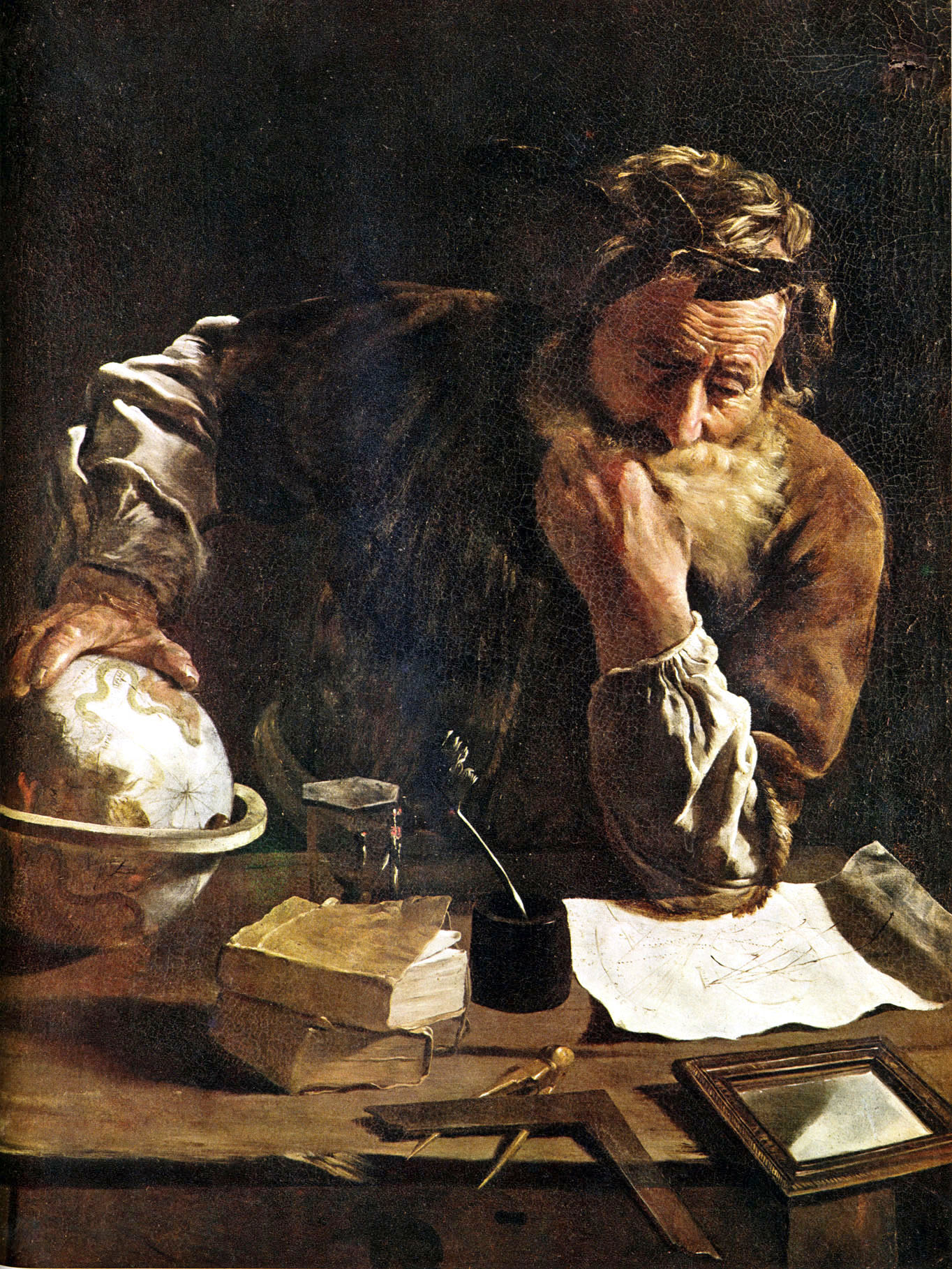
Today is the birthday of
- Archimedes
(287-212 BC). His birthday is not actually known, but we choose this day
to honor him.
Get an Archimedes rolled poster
Today’s Problem
The molecular flux in an ideal gas is the number of molecules that cross a unit area per unit time. Using kinetic theory, the flux can be shown to be equal to
\[\phi = \frac{1}{4}n\bar{v}\]
where \(n\) is the number density of molecules (molecules per unit volume), and \(\bar{v}\) is the average velocity which was calculated in the previous problem to be
\[\bar{v} = \sqrt{\frac{8kT}{\pi m}}\]
If we have an ideal gas in a container at pressure \(P\), and the container has a hole of area \(A\), how does the number of molecules inside the container change as a function of time?
Answer
Let \(dN_1\) and \(dN_2\) be the number of molecules leaving and entering the container respectively in time \(dt\). If \(N\) is the number of molecules in the container then \(dN=dN_2-dN_1\). Let \(V\) be the volume of the container and \(n\) be the number density of molecules in the atmosphere surrounding the container which we can assume remains constant. From the flux equation then we have
\[\begin{align} \frac{dN_1}{dt} & = \phi A = \frac{1}{4}\frac{N}{V}\sqrt{\frac{8kT}{\pi m}}A = \frac{AN}{V}\sqrt{\frac{kT}{2\pi m}}\\ \frac{dN_2}{dt} & = An\sqrt{\frac{kT}{2\pi m}}\\ \frac{dN}{dt} & = \frac{dN_2}{dt}-\frac{dN_1}{dt}=\frac{A}{V}\sqrt{\frac{kT}{2\pi m}}(Vn-N)=\alpha (Vn-N) \end{align}\] \[\alpha=\frac{A}{V}\sqrt{\frac{kT}{2\pi m}}\]
This first order differential equation can easily be solved using the Laplace transform method. Taking the transform of both sides we have
\[sN(s)-N_0=\alpha\left(\frac{Vn}{s}-N(s)\right)\]
where \(N_0\) is the number of particles in the container at time \(t=0\). Solving for \(N(s)\) we get
\[N(s)=\frac{\alpha Vn+N_0s}{s(s+\alpha)}=\frac{Vn}{s}+\frac{N_0-Vn}{s+\alpha}\]
Taking the inverse transform gives us the number of particles in the container as a function of time
\[N(t)=Vn+(N_0-Vn)e^{-\alpha t}\]
This can be checked by looking at \(t=0\) and \(\infty\). We get \(N(0)=N_0\) and \(N(\infty)=Vn\), as it should be.
© 2026 Stefan Hollos and Richard Hollos