
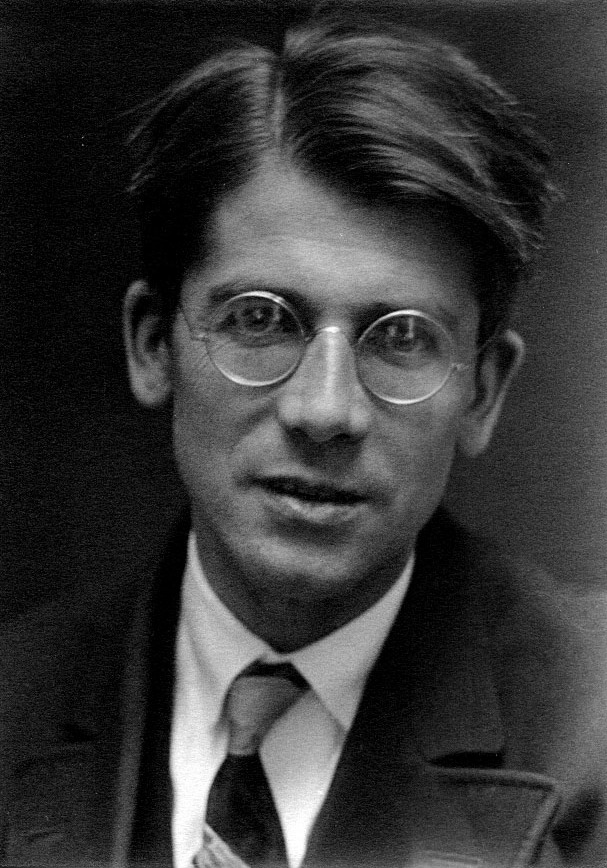
Rolf Landauer image courtesy of
AIP Emilio Segrè Visual
Archives, Physics Today Collection.
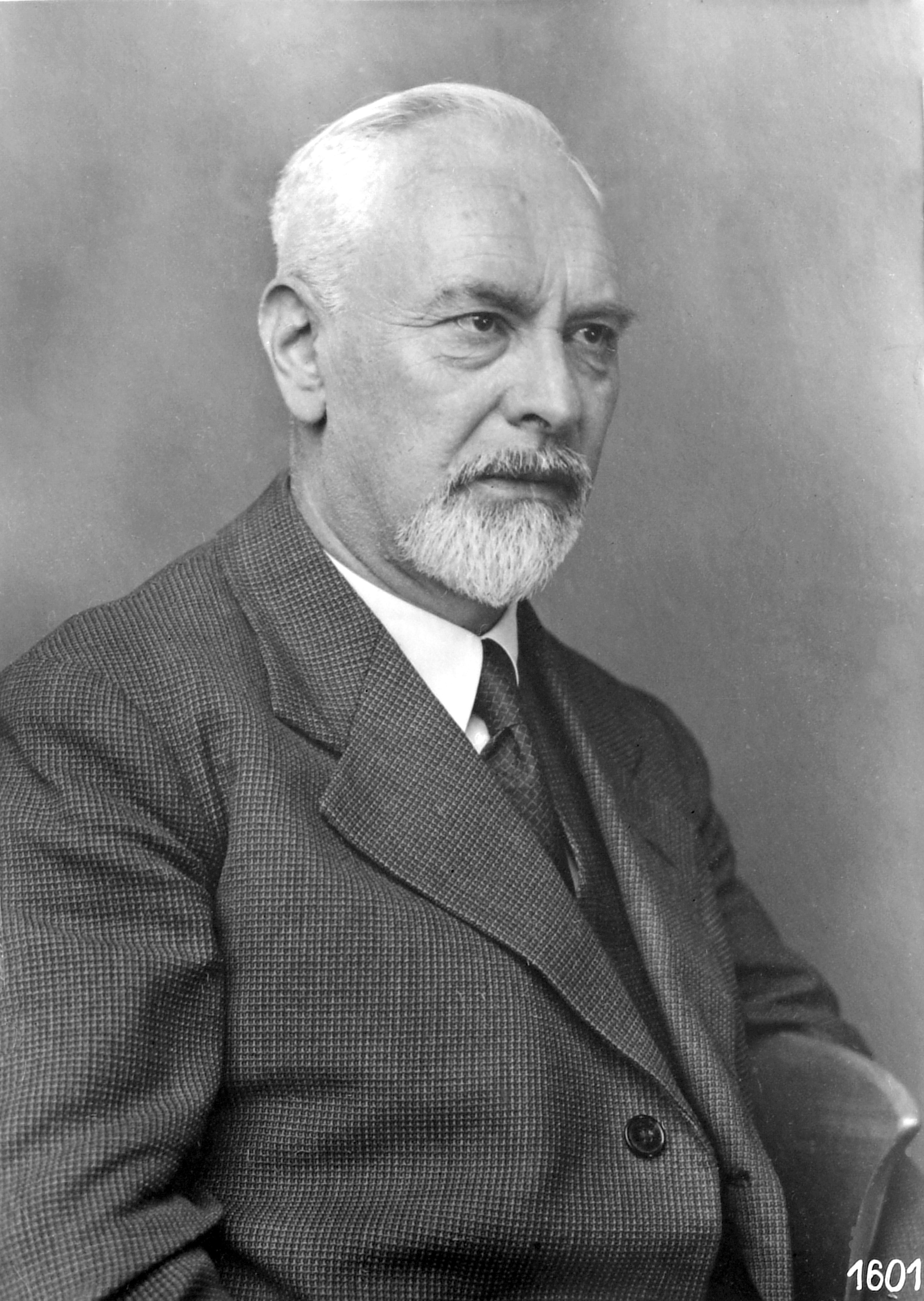
Friedrich Hund image courtesy of
Gerhard Hund
under the
Creative
Commons Attribution 3.0 Unported license.
Ludwig Prandtl image courtesy of
Deutsches Zentrum für Luft- und
Raumfahrt under the
Creative
Commons Attribution 3.0 Germany license.
Today is the birthday of
- Rolf
Landauer (1927-1999).
- Friedrich
Hund (1896-1997).
- Ludwig Prandtl (1875-1953).
Today’s Problem
Derive an expression for the change in density of air as a function of altitude.
Answer
Take a slab of air of thickness \(dz\). The bottom of the slab is at height \(z\) and top is at height \(z+dz\). At equilibrium the force pushing down on the bottom of the slab must equal the force pushing up.
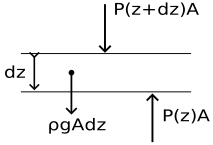
\[P(z+dz)A + \rho gAdz = P(z)A\]
Rearranging this equation, we get
\[\frac{P(z+dz)-P(z)}{dz} = -\rho g\]
In the limit \(dz\rightarrow 0\) this becomes the differential equation
\[\frac{dP}{dz}=-\rho g\]
From the ideal gas law we have
\[P=\frac{NkT}{V}=nkT\]
where
\(n=N/V =
\mathrm{molecules}/\mathrm{m}^3\)
\(\rho =mn\) where \(m=\) molecular mass
so the equation for \(dP/dz\) becomes
\[\frac{d(nkT)}{dz}=-mng\]
or
\[\frac{dn}{dz}=-\frac{mg}{kT}\,n\]
The solution of this equation is
\[n=n_0e^{-mgz/kT}\]
where
\(n_0=\) density at sea level \((z=0)\)
\(m=\) molecular mass of air
For practical calculations, we find it convenient to use the molar mass of air, \(\bar{m}=0.02896\) kg/mol. Writing
\[\frac{mg}{kT}=\frac{\bar{m}g}{RT}\]
and using \(R=8.314\) J/mol\(\cdot\)K, \(g=9.8\) m/s\(^2\), and \(T=20^{\circ}\)C\(=293\)K we get
\[n=n_0e^{-z(116.5\times 10^{-6}\,\mathrm{m}^{-1})}\]
where \(z\) is in meters. Substituting in \(z=1\)km we get \(n=0.89n_0\), and for \(z=10\)km we get \(n=0.31n_0\). This calculation assumes the air temperature is constant with altitude, but it tends to decrease with increasing altitude, making the effect not as dramatic.
© 2026 Stefan Hollos and Richard Hollos