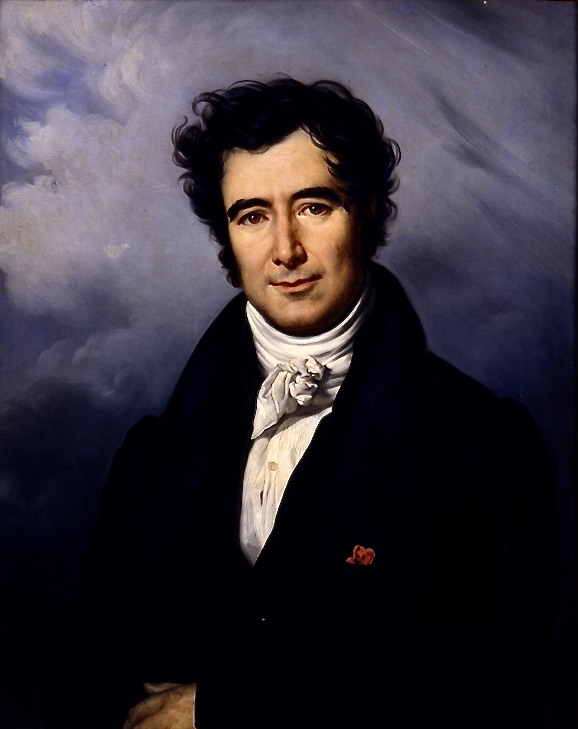
Today is the birthday of
- François Arago (1786-1853).
Today’s Problem
For the creation of ammonia from nitrogen and hydrogen, calculate the change in the Gibbs free energy. The chemical equation is \(N_2+3H_2\rightarrow 2NH_3\). Do the calculation for temperature \(T=298\,\)K and pressure \(P=10^5\,\)Pa.
Answer
The Gibbs free energy is defined as \(G=H-TS\) so we have \(\Delta G=\Delta H-T\Delta S\). From standard reference tables one finds that \(S\) for \(N_2+3H_2\) is \(191.61+3\times 130.68=583.65\,\)J/K and \(S\) for \(2NH_3\) is \(2\times 192.45=384.9\,\)J/K. So \(\Delta S\) for the reaction is \(384.9-583.65=-198.75\,\)J/K.
The tabulated value of \(\Delta H\) for ammonia is \(-46.11\,\)kJ therefor \(\Delta G\) for the process is \(\Delta G=2\times (-46.11)-298\times (-0.19875)=-33.216\,\)kJ. This is twice the tabulated value for \(NH_3\) since two moles are formed.
© 2026 Stefan Hollos and Richard Hollos