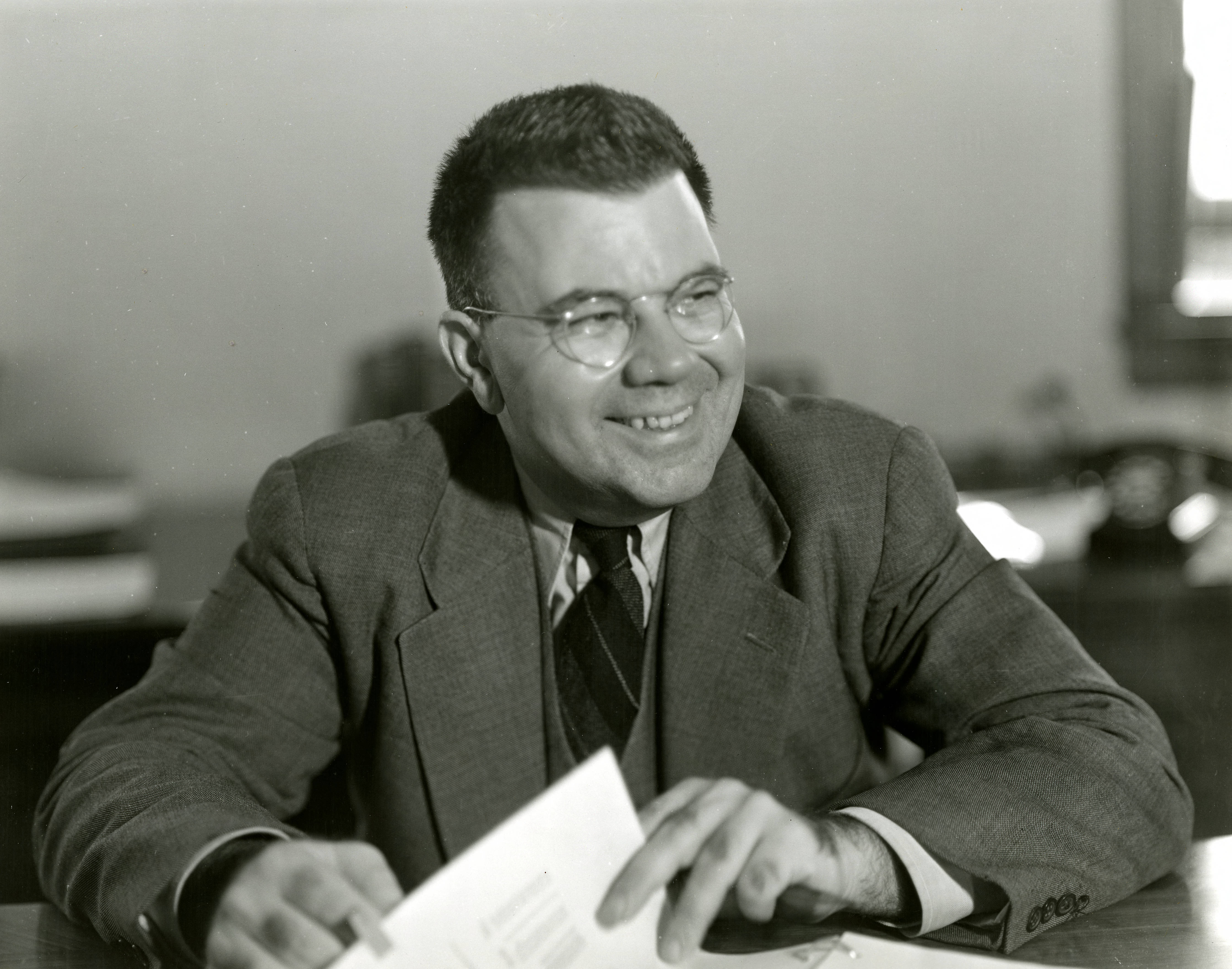
Today is the birthday of
- Edward Condon (1902-1974).
Today’s Problem
Find the capacitance of a cylindrical capacitor with inner radius \(a\), outer radius \(b\), and length \(h\). Assume no fringing of the electric field at the ends.
Answer
From Gauss’s law we can calculate the electric field assuming it is radial everywhere, even at the ends. If the total charge on the inner conductor is \(Q\) then using a cylindrical surface surrounding the inner conductor we have
\[E\oint dA = E2\pi rh = \frac{Q}{\epsilon_0}\]
So we have
\[E=\frac{Q}{2\pi\epsilon_0 rh}\]
To get the voltage across the capacitor we integrate this from \(r=a\) to \(r=b\). We have
\[V=\frac{Q}{2\pi\epsilon_0 h}\int_a^b\frac{dr}{r}=\frac{Q}{2\pi\epsilon_0 h}\ln\left(\frac{b}{a}\right)\]
The capacitance is then
\[C=\frac{Q}{V}=\frac{2\pi\epsilon_0 h}{\ln\left(\frac{b}{a}\right)}\]
© 2026 Stefan Hollos and Richard Hollos