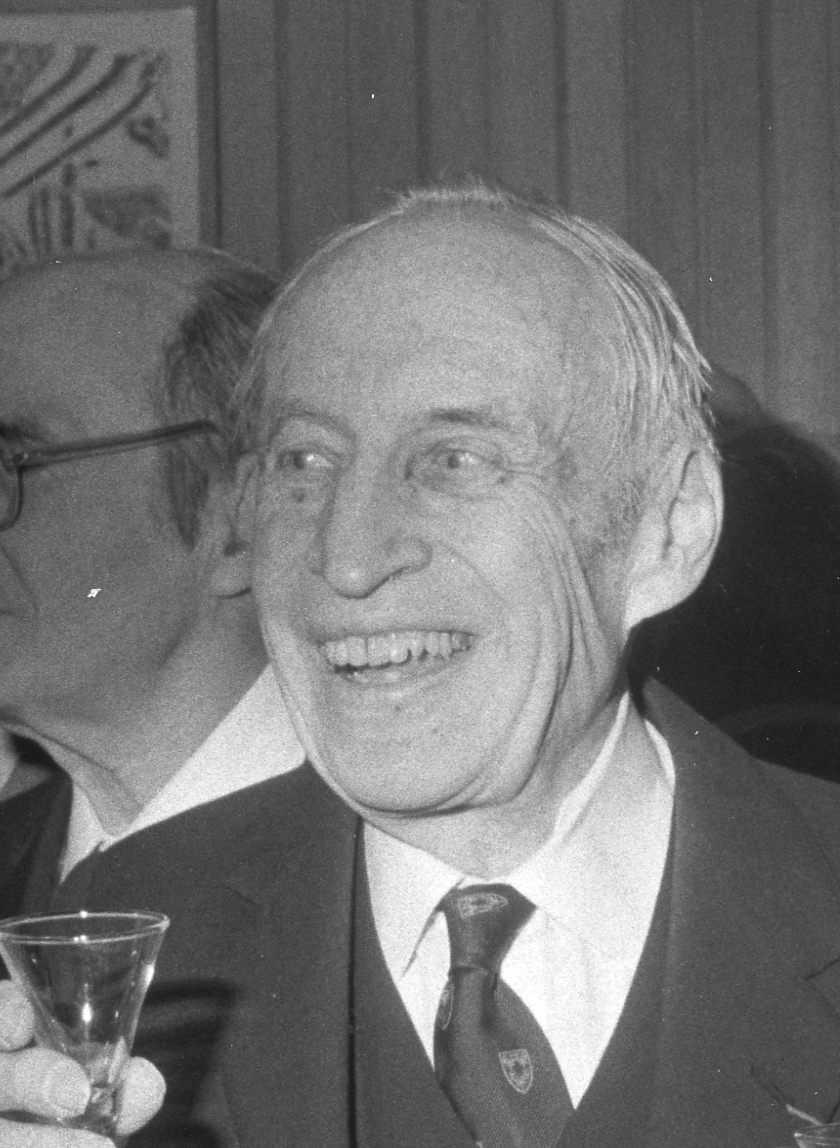
Van Vleck image courtesy of
American
Institute of Physics (AIP).
Today is the birthday of
- John Hasbrouck van Vleck (1899-1980).
Today’s Problem
Calculate the amount of electrical energy required to convert one mole of water into one mole of hydrogen and half a mole of oxygen using electrolysis. The reaction is \[H_2O \rightarrow H_2 + \frac{1}{2} O_2\]
Answer
The electrical energy is equal to the change in the Gibbs free energy for the reaction. To see this recall that the Gibbs free energy is defined as \[G = U - TS + PV\] The reaction takes place at constant temperature and pressure therefore \[\Delta G = \Delta U - T\Delta S + P\Delta V\]
\[\begin{eqnarray} \Delta U &=& \text{(heat added)} - \text{(work done by it)} + \text{(work done on it)}\\ &=& T\Delta S - P\Delta V + W \end{eqnarray}\]
where W is the electrical work. Substituting this into the expression for \(\Delta G\) we find that \(\Delta G=W\). The Gibbs free energy for the formation of liquid \(H_2O\) is -237.13 kJ/mol. In this case the reaction is in the opposite direction so that the work required is \(W=237.13\) kJ. The work can also be calculated using change in entropy and change in enthalpy for the reaction by using the fact that
\[\Delta G=\Delta H - T\Delta S\]
© 2026 Stefan Hollos and Richard Hollos